
How Golf Match finds you a game (and the golfers to play it with)
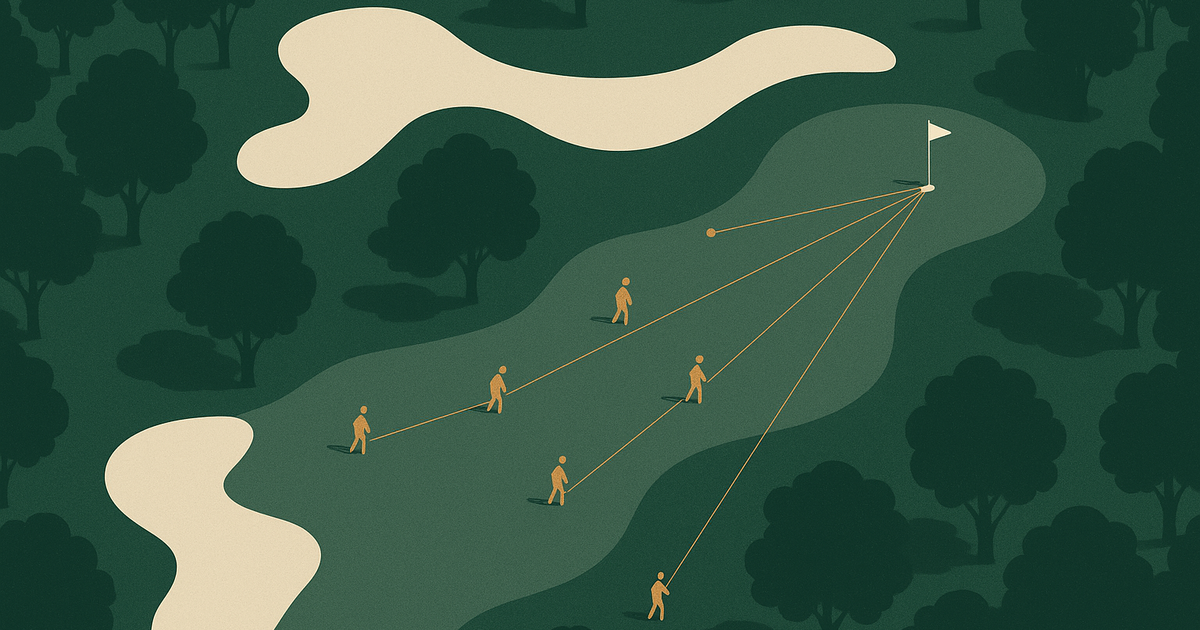
So how does Golf Match actually find you a game?
It's the question we get asked most. You tell us when you're free, and a little while later there's a group of golfers and a course waiting for a yes or no. What happened in between?
We wanted to explain it properly, partly because we think it's genuinely interesting, and partly because we'd rather be open about how it works than have it feel like a mystery box. We'll keep the exact recipe to ourselves (a chef has to keep something back), but here's the honest picture.
It starts with who's actually free
Everything begins with availability. Not "people who vaguely exist near you", but golfers who have told us they can play on the same day as you. That sounds obvious, but it's the bit most golf apps skip. A list of profiles is not a game of golf. Two people free on the same Sunday morning is the start of one.
So the first job the matcher does every day is simple: who's put their hand up for the same date?
Then it thinks like a golfer
From that pool, it weighs up the things you'd naturally consider yourself if a mate said "I know a bloke, fancy a fourball?"
- How far away are they? Nobody wants a playing partner who lives 90 minutes up the A12. We look at real distances between real postcodes, not just "same county". And there's a hard limit: if two golfers are simply too far apart to ever sensibly share a tee time, we won't match them, no matter how well they'd get on. We'd rather find you nobody this week than someone in Barnsley.
- Will the golf be compatible? A beginner and a scratch golfer can have a lovely time together, but most people are more comfortable playing with someone roughly in their bracket. Ability carries real weight in the match.
- When do you like to play? Early bird versus twilight matters more than people admit.
- What do you want to spend? No point matching someone hunting a cheap nine with someone who thinks nothing of £80 green fees.
- How do you like to play? Social and relaxed, or properly competitive.
None of these is a dealbreaker on its own (except distance). They're weighed together into an overall picture of whether a group would actually work, and only groups that clear a sensible bar get suggested.
Picking the course
Once there's a group, we pick somewhere to play. The matcher finds the middle ground of everyone's locations, then ranks nearby courses by actual distance so the venue is fair on the whole group, not just one person.
Two things nudge that ranking. A genuine offer from a club can pull a course up the list a little. And now, so can you: you can star courses you'd love to play (on the course page, or straight off the map), and the matcher treats those stars as a vote. If someone in your group has starred a course nearby, that's where it will lean. It's your golfing wish list quietly doing something useful.
One thing we deliberately don't do is quote green fees we can't stand behind. If a price shows up on a match, it's because the club themselves put it there. Otherwise we'll just tell you to confirm with the club, because guessing a price over a real club's name isn't fair on them or you.
Nobody gets left behind (any more)
Here's a real example of the matcher getting smarter, because it's an evolving thing and we think it's healthier to say so than pretend it arrived perfect.
Recently a new golfer signed up in Colchester, set his availability, and got nothing, even though there was a group forming ten minutes down the road with a spot free. Why? The matcher used to only build brand new groups. If your neighbours were already matched, you'd missed the boat until next time.
That's fixed now. The matcher first checks whether there's an existing group near you with room, and slots you in if you fit. New groups only get built from whoever's left. One frustrated golfer in Colchester made the matching better for everyone, which is rather the point.
Why we think we can get this right
A bit of background, since it's fair to ask who's behind this. Golf Match is built by a small team of founders who are golfers first. Amongst the team, Adam has spent the last 20 years working in data engineering and data analytics, and the matcher is where that shows. Matching people well is a data problem before it's anything else: clean inputs, sensible weighting, honest measurement of whether it worked. That's been his day job for two decades. Golf just makes it a much more enjoyable dataset.
That background is also why we're comfortable saying the matcher isn't finished. Nothing built with data ever is. Every accepted match, every declined one, every game that actually gets played teaches us something about what a good match looks like, and the weighting shifts as we learn.
What's next for it
Some of what's coming, in no particular order: preferred courses playing a bigger part in who gets matched in the first place, smarter handling of regulars who play together often, and better awareness of things like weather and daylight for twilight rounds.
If you've had a match that felt spot on, or one that felt off, tell us. Honestly, that feedback is worth more than any clever maths.
Fancy seeing it work? Set your availability and let it find you a game.
Find your next round with Golf Match
Get matched with playing partners and discover courses and society days near you. Free to join.